

Computer Vision
Program Overview: Computer Vision
The Computer Vision program from Carnegie Mellon University School of Computer Science Executive Education is a 10-week online learning experience designed for software developers, data scientists, and technology leaders like you looking to build core expertise in visual perception systems.
As image- and video-based data becomes central to industries ranging from manufacturing to robotics and autonomous vehicles, organizations increasingly need professionals who understand how machines interpret, analyze, and act on visual information. Through expert-led instructions, hands-on programming assignments, and applied examples, this program equips you with a detailed understanding of computer vision theory, neural networks, image processing, and real-world applications. In 10 weeks, you will gain the technical fluency to build, evaluate, and deploy computer vision solutions that scale across complex, real-world environments.
Carnegie Mellon University Is Ranked #1 in Artificial Intelligence (AI) and Graduate Programs for Computer Science
SOURCE: U.S. NEWS & WORLD REPORT
Key Takeaways: Computer Vision Program
In this program, you will:
Implement fundamental image processing methods and learn about various techniques used in them
Use neural networks to perform image recognition and classification
Extract 3D information from images and learn the basic principles of geometry-based vision
Align and track objects in a video
What You Will Learn in the Computer Vision Program
Module 1: Introduction to Computer Vision
Deep dive into the key concepts of computer vision and the real-world applications of this technology.
Module 2: Image Processing
Explore the basic principles of image processing and learn the various techniques used for image filtering and decomposition.
Module 3: Feature Detection and Matching
Feature detection is a cornerstone of computer vision. Explore essential feature-detection methods, and use them to build and train algorithms to detect corners and visualize quadratics in images.
Module 4: Image Classification and Neural Networks
Leverage your experience in ML to create image representations with features using the Bag-of-Visual Words concept. Learn to use neural networks to classify images.
Module 5: Convolutional Neural Networks (CNNs)
Learn about the structure and function of CNNs, using a deep CNN to recognize objects in an image.
Module 6: Transformation and Homographies
Learn to apply 2D planar and linear transformations to given images, the process of performing automatic image warping, and explore basic augmented-reality simulations.
Module 7: Camera Models
Learn the basics of geometric camera models and how to calibrate a camera.
Module 8: Geometry-Based Vision
Discover the basic principles of geometry-based vision, learn to reconstruct 3D scene structures from 2D images, and perform robust 3D sensing using stereo.
Module 9: Dealing With Motion
Study the applications of optical flow and track objects in a video.
Module 10: Physics-Based Vision
Understand the function of physics-based vision in interpreting and extracting information from an image, and perform photometric stereo for rendering simple images.
Program Highlights

Office Hours With Learning Facilitators

Programming Assignments

Recorded Videos

Knowledge Checks

Dedicated Program Support Team

Discussion Boards

Bite-Sized Learning
Who Is This Program For?
The Computer Vision program is ideal for:
Software developers and technology professionals looking to explore computer vision tools and advance their careers. Representative roles include:
Software engineer
Software developer
Automation engineer
Tester design
Engineer
Full-stack developer
Tech lead
Data science, data analysis and machine learning professionals seeking to improve their knowledge of computer vision technologies and applications across industries. Representative roles include:
Data scientist
ML engineer
AI application engineer
Data engineer
Senior data engineer
ML developer
ML research engineer
Data analyst
Prerequisites: this program requires a functional knowledge of linear algebra, calculus, probability, and statistics. Participants should be comfortable programming in Python. Programming assignments will present opportunities to implement computer vision algorithms using these technologies.
Why Carnegie Mellon University School of Computer Science?
At Carnegie Mellon University’s Executive Education Program in the School of Computer Science, we provide organizations and people access to the skills and tools necessary to solve real-world technical problems by equipping the next generation of technology leaders with the experience, insights and novel solutions developed by our community of computer science experts. From custom training programs to online individualized learning, our cutting-edge programming—backed by faculty who pioneered the field—takes your skillset to the next level, giving you the tools to tackle your organization’s next technological challenge.
Meet the Faculty

Kris Kitani
Associate Research Professor, Robotics Institute, School of Computer Science Courtesy Professor, Electrical and Computer Engineering Department, Carnegie Mellon University
Kris Kitani works in the areas of computer vision, machine learning, and human–computer interaction. His research interests lie at the intersection of first-person vision, hum...

Ioannis Gkioulekas
Assistant Professor, Robotics Institute, Carnegie Mellon University
Ioannis Gkioulekas works on computational imaging—the process of image formation from measurements using algorithms that require substantial computing. His research interests ...
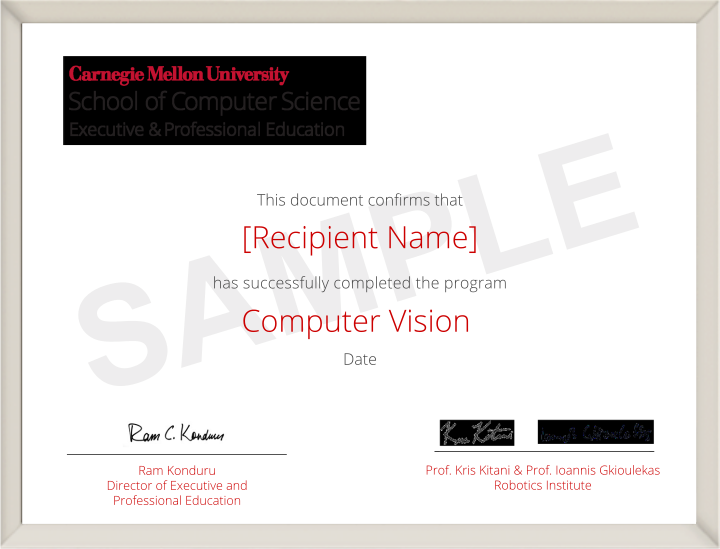
Certificate
Upon successful completion of the program, participants will receive a verified digital certificate of completion from Carnegie Mellon University School of Computer Science Executive Education. This is a training program, and it is not eligible for academic credit.
Your digital certificate will be issued in your legal name and emailed to you, at no additional cost, upon completion of the program, per the stipulated requirements.
Your digital certificate will be issued in your legal name and emailed to you at no additional cost, upon completion of the program, per the stipulated requirements. All certificate images are for illustrative purposes only and may be subject to change at the
FAQs
Who is this Computer Vision course designed for?
The Computer Vision online program from Carnegie Mellon University School of Computer Science Executive Education is intended for software developers, engineers, machine learning professionals, and technology leaders who want to strengthen their understanding of computer vision. It is best suited for learners seeking to deepen their practical and conceptual skills, rather than those looking for a purely research-focused or domain-specific program.
What prior knowledge is required for this Computer Vision course?
Participants are expected to have prior knowledge of Python programming and mathematics, including linear algebra and basic probability. The course is designed to accommodate learners with varying levels of professional experience, as long as these prerequisites are met.
Does this course include deep learning for computer vision?
The program introduces deep learning for computer vision through CNNs. Participants build and train a simple neural network, then work with deeper CNN architectures to perform visual recognition tasks.
Is this the best computer vision course for aspiring experts?
The Computer Vision online course from Carnegie Mellon University School of Computer Science Executive Education is designed to build strong foundational skills in computer vision. Led by renowned faculty with cutting-edge research expertise, the program equips participants with a structured learning path with practical projects across image processing, feature detection, neural networks, geometry-based vision, and motion analysis—providing the technical grounding needed to work confidently with computer vision systems or pursue more advanced study and specialization.
Are facial recognition or face detection techniques taught?
Facial recognition may be referenced as examples of visual recognition tasks, but the curriculum focuses on general-purpose techniques rather than specialized biometric systems like facial keypoint detection.
Is medical imaging or disease detection part of the curriculum?
Medical imaging and disease detection are discussed only as application contexts for computer vision. The program does not train clinical models or diagnostic systems, and examples are provided for educational purposes only.
Does the program include natural language processing or generative AI?
Natural language processing, generative AI, automatic image captioning, movie reviews, and recurrent neural networks are not part of this curriculum. The program remains focused on visual data, image-based learning, and classical and deep vision techniques.
The Program
How do I know if this program is right for me?
After reviewing the information on the program landing page, we recommend you submit the short form above to gain access to the program brochure, which includes more in-depth information. If you still have questions on whether this program is a good fit for you, please email learner.success@emeritus.org, and a dedicated program advisor will follow-up with you very shortly.
Are there any prerequisites for this program?
Some programs do have prerequisites, particularly the more technical ones. This information will be noted on the program landing page, as well as in the program brochure. If you are uncertain about program prerequisites and your capabilities, please email us at the ID mentioned above.
Note that, unless otherwise stated on the program web page, all programs are taught in English and proficiency in English is required.
What is the typical class profile?
More than 50 percent of our participants are from outside the United States. Class profiles vary from one cohort to the next, but, generally, our online certificates draw a highly diverse audience in terms of professional experience, industry, and geography — leading to a very rich peer learning and networking experience.
What other dates will this program be offered in the future?
Check back to this program web page or email us to inquire if future program dates or the timeline for future offerings have been confirmed yet.
The Learning Experience
How much time is required each week?
Each program includes an estimated learner effort per week. This is referenced at the top of the program landing page under the Duration section, as well as in the program brochure, which you can obtain by submitting the short form at the top of this web page.
How will my time be spent?
We have designed this program to fit into your current working life as efficiently as possible. Time will be spent among a variety of activities including:
Engaging with recorded video lectures from faculty
Attending webinars and office hours, as per the specific program schedule
Reading or engaging with examples of core topics
Completing knowledge checks/quizzes and required activities
Engaging in moderated discussion groups with your peers
Completing your final project, if required
The program is designed to be highly interactive while also allowing time for self-reflection and to demonstrate an understanding of the core topics through various active learning exercises. Please email us if you need further clarification on program activities.|
What is it like to learn online with the learning collaborator, Emeritus?
More than 300,000 learners across 200 countries have chosen to advance their skills with Emeritus and its educational learning partners. In fact, 90 percent of the respondents of a recent survey across all our programs said that their learning outcomes were met or exceeded.
All the contents of the course would be made available to students at the commencement of the course. However, to ensure the program delivers the desired learning outcomes the students may appoint Emeritus to manage the delivery of the program in a cohort-based manner the cost of which is already included in the overall course fee of the course.
A dedicated program support team is available 24/5 (Monday to Friday) to answer questions about the learning platform, technical issues, or anything else that may affect your learning experience.
How do I interact with other program participants?
Peer learning adds substantially to the overall learning experience and is an important part of the program. You can connect and communicate with other participants through our learning platform.
Certification
What are the requirements to earn the certificate?
Each program includes an estimated learner effort per week, so you can gauge what will be required before you enroll. This is referenced at the top of the program landing page under the Duration section, as well as in the program brochure, which you can obtain by submitting the short form at the top of this web page. All programs are designed to fit into your working life.
This program is scored as a pass or no-pass; participants must complete the required activities to pass and obtain the certificate of completion. Some programs include a final project submission or other assignments to obtain passing status. This information will be noted in the program brochure. Please email us if you need further clarification on any specific program requirements.
What type of certificate will I receive?
Upon successful completion of the program, you will receive a smart digital certificate. The smart digital certificate can be shared with friends, family, schools, or potential employers. You can use it on your cover letter, resume, and/or display it on your LinkedIn profile. The digital certificate will be sent approximately two weeks after the program, once grading is complete.
Can I get the hard copy of the certificate?
No, only verified digital certificates will be issued upon successful completion. This allows you to share your credentials on social platforms such as LinkedIn, Facebook, and Twitter.
Do I receive alumni status after completing this program?
No, there is no alumni status granted for this program. In some cases, there are credits that count toward a higher level of certification. This information will be clearly noted in the program brochure.
How long will I have access to the learning materials?
You will have access to the online learning platform and all the videos and program materials for 24 months following the program start date. Access to the learning platform is restricted to registered participants per the terms of agreement.
Technical Requirements
What equipment or technical requirements are there for this program?
Participants will need the latest version of their preferred browser to access the learning platform. In addition, Microsoft Office and a PDF viewer are required to access documents, spreadsheets, presentations, PDF files, and transcripts.
Do I need to be online to access the program content?
Yes, the learning platform is accessed via the internet, and video content is not available for download. However, you can download files of video transcripts, assignment templates, readings, etc. For maximum flexibility, you can access program content from a desktop, laptop, tablet, or mobile device.
Video lectures must be streamed via the internet, and any livestream webinars and office hours will require an internet connection. However, these sessions are always recorded, so you may view them later.
Payment Process
Can I still register if the registration deadline has passed?
Yes, you can register up until seven days past the published start date of the program without missing any of the core program material or learnings.
What is the program fee, and what forms of payment do you accept?
The program fee is noted at the top of this program web page and usually referenced in the program brochure as well.
Flexible payment options are available (see details below as well as at the top of this program web page next to FEE).
Tuition assistance is available for participants who qualify. Please email learner.success@emeritus.org.
What if I don’t have a credit card? Is there another method of payment accepted?
Yes, you can do the bank remittance in the program currency via wire transfer or debit card. Please contact your program advisor, or email us for details.
I was not able to use the discount code provided. Can you help?
Yes! Please email us with the details of the program you are interested in, and we will assist you.
How can I obtain an invoice for payment?
Please email us your invoicing requirements and the specific program you’re interested in enrolling in.
Is there an option to make flexible payments for this program?
Yes, the flexible payment option allows a participant to pay the program fee in installments. This option is made available on the payment page and should be selected before submitting the payment.
How can I obtain a W9 form?
Please connect with us via email for assistance.
Who will be collecting the payment for the program?
Emeritus collects all program payments, provides learner enrollment and program support, and manages learning platform services.
Are there any restrictions on the types of funding that can be used to pay for the program?
Program fees for Emeritus programs with Carnegie Mellon University’s School of Computer Science Executive Education may not be paid for with (a) funds from the GI Bill, the Post-9/11 Educational Assistance Act of 2008, or similar types of military education funding benefits or (b) Title IV financial aid funds.
Refund Policy
What is the program refund and deferral policy?
For the program refund and deferral policy, please click the link here.
Accessibility
How does Emeritus support accessibility for learners?
Emeritus is committed to making high-quality education accessible and affordable to individuals, companies, and governments around the world. If you have questions about accessibility or would like to discuss available support options before enrolling, please contact accessibility@emeritus.org. For more information about our accessibility practices, please review our Accessibility Policy here.
Didn't find what you were looking for? Write to us at learner.success@emeritus.org or Schedule a call with one of our Program Advisors or call us at +1 315 756 3771 (US) / +44 203 835 5826 (UK) / +65 3138 2533 (SG)
Flexible payment options available.
Starts On